.jpg)
Giovanni Martinelli is for me the greatest tenor of the recorded era: what I wouldn’t give to have heard live his performances of Otello or Il Trovatore. Luckily he was quite well recorded, albeit not always in the best quality (his best recordings were made between about 1915 and 1941 so that is not so surprising), but they do none-the-less capture the excitement and quality of the voice. A short biography of Martinelli can be found here, Biography, whilst reviews and opinions about him can be found below.
In this section I will look what has been written about Martinelli, including reviews of his performances, retrospective appraisals of his singing, and I will look at the records and CDs that are available now for Giovanni Martinelli and where possible also look at the reviews and reaction to these releases.
Martinelli's reportory which I have taken from this website (now requires authorisation).
Aida (Messenger)-Montagnana, Sociale, 12 September 1908
Ernani-Milano, Dal Verme, 29 December 1910
Ruy Blas-Milano, Dal Verme, 15 February 1911
Un Ballo in Maschera-Ancona, delle Muse, 1911
La Fanciulla del West-Roma, Costanzi, 15 June 1911
Aida-Torino, Vittorio Emanuele, 9 October 1911
Tosca-London, Covent Garden, 22 April 1912
Manon Lescaut-London, Covent Garden, 19 June 1912
Melenis-Milano, Dal Verme, 13 November 1912
Yato-Monte Carlo, 3 March 1913
I Gioielli della Madonna-London, Covent Garden, 23 May 1913
Madama Butterfly-London, Covent Garden, 16 June 1913
La Dubarry-London, Covent Garden, 3 July 1913
Pagliacci-London, Covent Garden, 19 July 1913
La Bohème-Baltimore, ?, 15 November 1913
Il Trovatore-Monte Carlo, 17 February 1914
I Mori di Valenza-Monte Carlo, 18 March 1914
Francesca da Rimini-London, Covent Garden, 16 July 1914
Madame Sans-Gêne-New York, MET, 25 January 1915
Carmen-New York, MET, 18 March 1915
Les Huguenots-Atlanta, ?, 26 April 1915
Goyescas-New York, MET, 28 January 1916
Lucia di Lammermoor-New York, MET, 31 January 1916
Lakmé-New York, MET, 24 March 1917
Faust-New York, MET, 17 November 1917
L'amore dei tre Re-New York, MET, 6 April 1918
Oberon-New York, MET, 1 December 1919
Eugene Onegin-New York, MET, 24 March 1920
Zaza-New York, MET, 17 April 1920
Don Carlos-New York, MET, 3 January 1921
Monna Vanna-Buenos Aires, Colón, 30 July 1921
La Forza del Destino-New York, MET, 31 March 1922
Samson et Dalila-New York, MET, 6 April 1922
Guglielmo Tell-New York, MET, 5 January 1922
Fedora-New York, MET, 8 December 1923
La Juive-New York, MET, 12 December 1924
Andrea Chenier-Chicago, Ravinia, August 1926
Le Prophète-New York, MET, 31 December 1927
La Campana Sommersa-New York, MET, 24 November 1924
Simon Boccanegra-New York, MET, 28 January 1932
L'Africaine-New York, MET, 28 December 193
La Gioconda-New York, MET, 2 March 1934
Otello-San Francisco, War Memorial, 20 November 1936
Turandot-London, Covent Garden, 30 April 1937
Norma-Chicago, Opera House, 22 November 1937
Tristan und Isolde-Chicago, 24 November 1939
Turandot (Emperor)-Seattle, Opera House, 31 January 1967
Reference: The Record Collector, Volume 25, Nos. 7/8/9, October 1979.
Giovanni Martinelli, The British Institute of Recorded Sound, May 1962 .
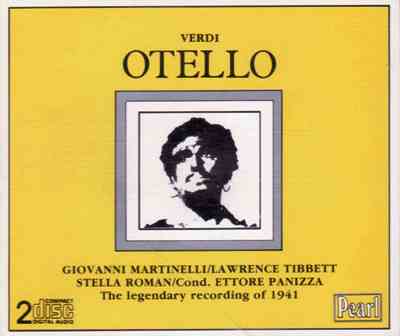
Let's start with the CD that first introduced me to that great tenor, the 1941 Otello recording. This recording is released by Pearl, GEMM 267-9 and features, with Martinelli, Lawrence Tibbett as Iago, Stella Roman as Desdemona and Alessio de Paolis as Cassio, and the performance is live from the Metropolitan, on the 4th December 1941, conducted by Ettore Panizza.
The exemplary sleeve notes are by Alan Blyth and the performance as I have mentioned ingrains itself on the memory: in Alan Blyth's words, 'Never in my experience of modern performances has the cut and thrurst of musical speech encountered here been equalled.' Blyth writes in some detail about certain key passages, for example, 'and in that one aching phrase Otello/Martinelli encapsulates his whole tragedy as Martinelli invests it with an almost unbearably sad sigh of remembrance.'
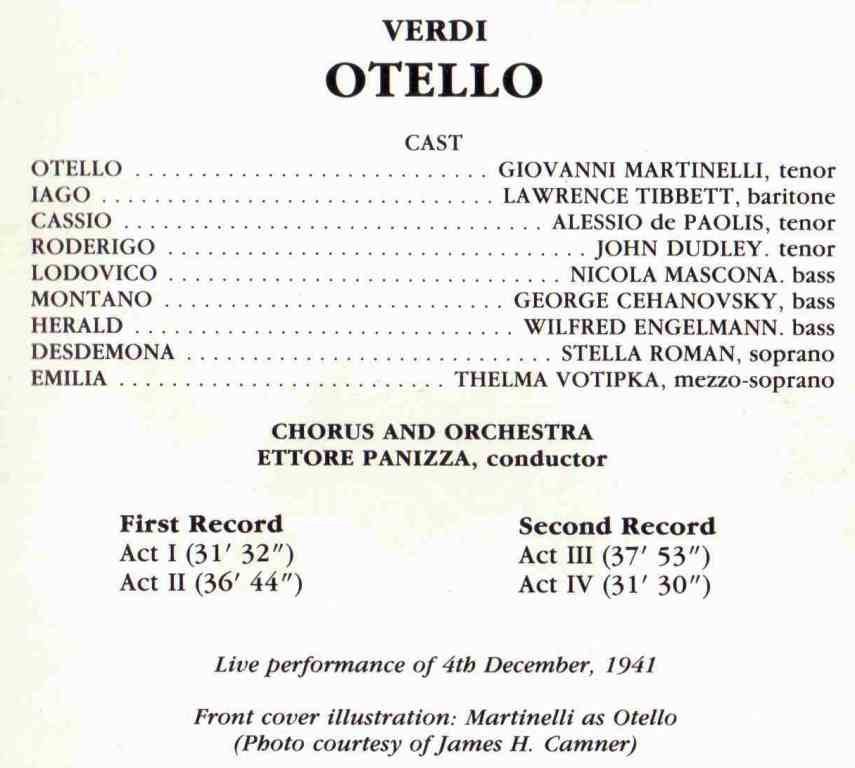
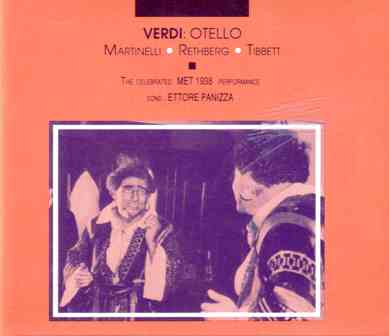
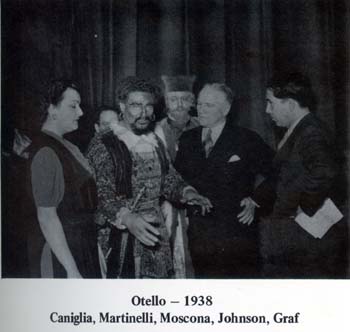
A second release of a live Metropolitan Otello followed from Music and Arts, CD645. This performance of 12th February 1938, offers better sound, with the continued benefits of Tibbett and Panizza and also with the advantage of Elizabeth Rethberg replacing Roman. Martinelli is also in fresher voice then.
I quote from the sleeve notes by
John L. Briggs, 'The tight, intense timbre of Martinelli's voice -
like chevre, caviar and oysters - is often an acquired taste, and then
becomes an addiction. There are no mannerisms with Martinelli, just
impeccable breath control and phrasing. His diction, like Tito Schipa's
was so perfect you could take diction from it if you knew shorthand.
There's a sense of elegance, of timing, and of the meaning of text
that are unsurpassed in my experience. Listen to the control and timing
in Esultate! or the passion and intensity in the love duet, the fury
of his long second act scene with Iago, the resignation and despair
of the end. It is, to 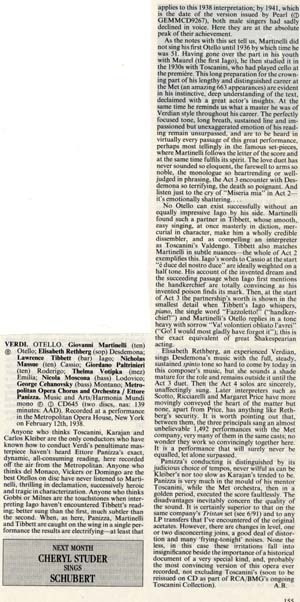 me,
beyond all praise.'
me,
beyond all praise.'
A review of this performance in the Gramophone magazine by Alan Blyth is shown on the right: I quote, 'The perfectly focussed tone, long breath, sustained line and impassioned but unexaggerated emotion of his reading remain unsurpassed....and listen just to the cry of "Miseria mia" in Act II - it's emotionally shattering...'.
Try this short extract (1.04Mbytes)
from this performance, as Otello questions Desdemona with increasing
fury about the whereabouts of the handkerchief he gave her: 
Martinelli talked of his assumption of the role of Otello: 'Otello was an opera which I had thought about and prepared for for many years. I had discussed the character of Otello with Arrigo Boito as far back as 1916 after I had heard Zanatello sing the part. In 1912 I had also heard Franz sing the role in London. I finally decided I could sing the opera after I had got thtrough Respighi's La Campana Sommersa at the Metropolitan. The terrific strain of dramatic declamation and repeated high notes had not hurt my voice and I now felt I should begin a serious study of Otello. I was then 45 years of age. I sang part of the second act that season of 1930 at a Sunday night concert with Giuseppe Danise. Years before I had also been over Otello's part carefully with Victor Maurel, who had created Iago at the initial performance under Verdi's direction. I then went to Toscanini and asked for his help. Toscanini also had participated in the initial performance as a cellist in the orchestra.
"I, frankly, was frightened. The
intensity of the declamation could ruin my voice and despite the glory
and grandeur which I hoped to achieve, I could arrive with nothing.
I loved my lyrico-spinto reportoire - especially the Lucias, the Lakmes
and the Bohemes and the Fausts which I had been singing. Would Otello
 compensate if I had to give these up? I wondered - and proceeded to
absorb the score slowly. Toscanini pointed out to me that for every
three pages of dramatic declamation in the score there were seven pages
which were lyric and that by emphasis on accent and diction I could,
with the dramatic intensity of the text, convey the impression of a
dramatic voice. I did not have the power of a Tamagno or
the baritone qualities of a Zanatello. I was still a spinto and as
a spinto I had to sing. Otello's opening war cry is the most difficult
bit of declamation in the score. Far back on the stage one must thunder
forth the phrases of Esultate! L'orgoglio musulmano sepolto e in mar,
nostra e del ciel e gloria! Dopo l'armi lo vinse l'uragano. Just 40
seconds of singing topped by a high B. It was some entrance - but then
the long and beautiful love duet with the phrase - Gia nella notte
densa - had to have a lyric line and a sustained legato. In the middle
of this duet come the words Tuoini la guerra - thundering of war -
this must be dramatic - but it should be uttered as a dramatic phrase
and not sung in a manner to distort or destroy the line. The second
act is also lyric - even Ora e per sempre addio. Only the recitative
- Tu? Indietro! Fuggi! - M'hai legato alla croce! - dramatic but that
drama is conveyed in words. However, when Si pel ciel arrives one must
summon voice and give with all the power at one's command or be drawfed
by the baritone and the floods of orchestration Verdi loosened at this
point. Dio! mi potevi scagliar
- is also expressed in a half-choked, half-demented voice, as the almost
suffocated Otello says Dio! m potevi - scagliar - tutti i mali - della
miseria - della vorogna etc. Only two-thirds through the aria does
Otello begin to give more than half voice and he virtually chokes with
his final B flat. His asides on his throne are also lyric utterances
and only occassionally does he give vent to an animalistic scream which
is not a beautiful sound but is expressive of his agony, as for instance,
Anima mia, ti maledico. His farewell, the glory of his life gone, is
sung in a style more reminiscent of a parlando with an occassional
lyric flash as the exhausted and beaten man prepares for his own death
- Nium mi tema etc., and his final words Un altro bacio are a whisper
as he dies. Otello can be exhausting from a vocal standpoint, but the
union of the fabulous power of Verdi with the magnificent text of Boito
can exhaust a man just in speaking the part, let alone singing it.
I first sang Otello in 1936 in San Francisco at 51 years of age. Then
in the spring of 1937, I had the honour of singing the part in London
during the Coronation season and then in December of 1937, at the Metropolitan.
My final Otello was in 1947 in Philadelphia, when I was 62 years of
age."
compensate if I had to give these up? I wondered - and proceeded to
absorb the score slowly. Toscanini pointed out to me that for every
three pages of dramatic declamation in the score there were seven pages
which were lyric and that by emphasis on accent and diction I could,
with the dramatic intensity of the text, convey the impression of a
dramatic voice. I did not have the power of a Tamagno or
the baritone qualities of a Zanatello. I was still a spinto and as
a spinto I had to sing. Otello's opening war cry is the most difficult
bit of declamation in the score. Far back on the stage one must thunder
forth the phrases of Esultate! L'orgoglio musulmano sepolto e in mar,
nostra e del ciel e gloria! Dopo l'armi lo vinse l'uragano. Just 40
seconds of singing topped by a high B. It was some entrance - but then
the long and beautiful love duet with the phrase - Gia nella notte
densa - had to have a lyric line and a sustained legato. In the middle
of this duet come the words Tuoini la guerra - thundering of war -
this must be dramatic - but it should be uttered as a dramatic phrase
and not sung in a manner to distort or destroy the line. The second
act is also lyric - even Ora e per sempre addio. Only the recitative
- Tu? Indietro! Fuggi! - M'hai legato alla croce! - dramatic but that
drama is conveyed in words. However, when Si pel ciel arrives one must
summon voice and give with all the power at one's command or be drawfed
by the baritone and the floods of orchestration Verdi loosened at this
point. Dio! mi potevi scagliar
- is also expressed in a half-choked, half-demented voice, as the almost
suffocated Otello says Dio! m potevi - scagliar - tutti i mali - della
miseria - della vorogna etc. Only two-thirds through the aria does
Otello begin to give more than half voice and he virtually chokes with
his final B flat. His asides on his throne are also lyric utterances
and only occassionally does he give vent to an animalistic scream which
is not a beautiful sound but is expressive of his agony, as for instance,
Anima mia, ti maledico. His farewell, the glory of his life gone, is
sung in a style more reminiscent of a parlando with an occassional
lyric flash as the exhausted and beaten man prepares for his own death
- Nium mi tema etc., and his final words Un altro bacio are a whisper
as he dies. Otello can be exhausting from a vocal standpoint, but the
union of the fabulous power of Verdi with the magnificent text of Boito
can exhaust a man just in speaking the part, let alone singing it.
I first sang Otello in 1936 in San Francisco at 51 years of age. Then
in the spring of 1937, I had the honour of singing the part in London
during the Coronation season and then in December of 1937, at the Metropolitan.
My final Otello was in 1947 in Philadelphia, when I was 62 years of
age."
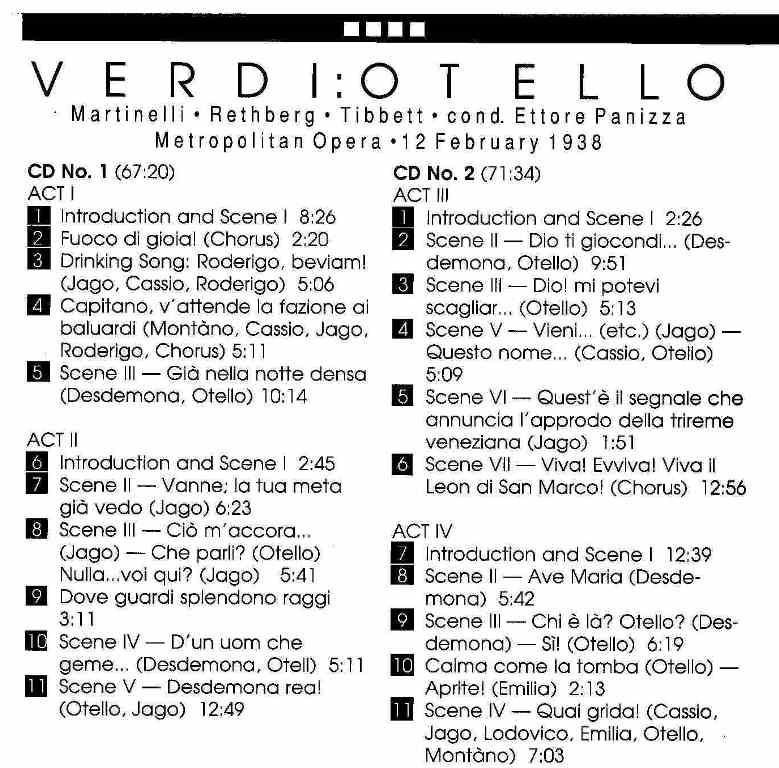
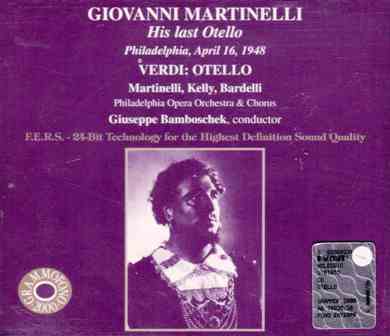
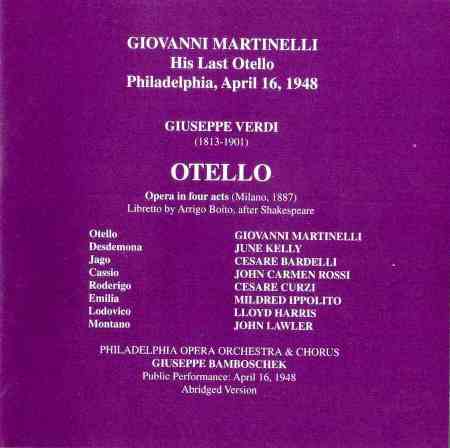
That last Otello performance from April 16th, 1948 in Philadephia is also available on CD, Grammofono AB 78 935/36 although it is an abridged version with June Kelly as Desdemona and Cesare Bardelli as Iago and conducted by Giuseppe Bamboschek. The details for that recording are shown below.
There are reportedly two more Martinelli Otellos available, a 1940 recording with Rethberg and Tibbett and a 1938 recording with Caniglia and Tibbett. John Steane writes about the former performance in his book, The Grand Tradition: 'The best of the complete recordings from the stage is that taken on 24th February 1940. Rethberg is recognisably 'the worlds greatest soprano' again here, and Tibbett is the excellent Iago. Panizza conducts with decision and flexibility, at a fantastically fast allegro in the first scene, very much school-of-Toscanini in drive and intensity, but allowing a relaxation of tempo and more room for the expression of tenderness than in Toscanini's recording. 'Esultate' and 'Abbasso le spade' command attention by the tense, knife edge cleaness, and an essential chafing in Otello is caught as the blood begins to rebel. The love duet draws it lines in long, smooth curves, retracts to a pianissimo that expresses this inheld emotion in which there is the tension of fear for the future ('I do fear my soul hath her content so absolute....'). Martinelli is specific in his grasp of that particular phrase in the Italian, the pathos of its irony made implicit in his tone; and this is typical, for from Iago's first insinuations we are to see the suffering Otello as in some kind of X-ray of the nerves, the neurosis of unsure power, remaining aristocratic and commanding however the weakness and anguish are exposed. It would take a separate essay to comment analytically, but every phrase calls forth its own colouring and distinction, from the lurking sadness in 'Quel canto mi conquide' to the fury and loathing of 'quella vil cortigiana che e sposa d'Otello'.
Martinelli's Otello was the last grand creation of an epoch. It marked the climax of his career and the end of an age.'
An excellent review of Martinelli's Otello can be found in John Steane's book, Voices, Singers and Critics.
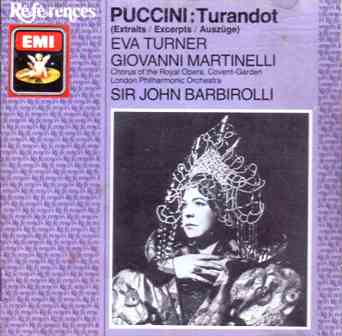
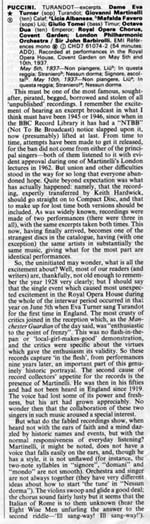
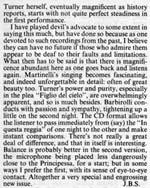 One
of the most legendary performances of Martinelli's career was his performance
of Turandot given during the Queens Coronation year of 1937. The performance
seemed to be the subject of various contractual arguments which delayed
its release, but fortunately the extracts are now available on a CD,
(EMI CDH761074 2), albeit only as tantalizing extracts. To quote the
sleeve notes of Richard Bebb, 'With John Barbirolli at his magical
best in the pit, and two of the greatest voices of this century singing
with total commitment and a white-hot intensity of expression, these
recording are, without doubt, among the most valuable that the gramophone
has preserved for us.' You can also read, on the left, a review of
this CD by John Steane, from the Gramophone magazine.
One
of the most legendary performances of Martinelli's career was his performance
of Turandot given during the Queens Coronation year of 1937. The performance
seemed to be the subject of various contractual arguments which delayed
its release, but fortunately the extracts are now available on a CD,
(EMI CDH761074 2), albeit only as tantalizing extracts. To quote the
sleeve notes of Richard Bebb, 'With John Barbirolli at his magical
best in the pit, and two of the greatest voices of this century singing
with total commitment and a white-hot intensity of expression, these
recording are, without doubt, among the most valuable that the gramophone
has preserved for us.' You can also read, on the left, a review of
this CD by John Steane, from the Gramophone magazine.
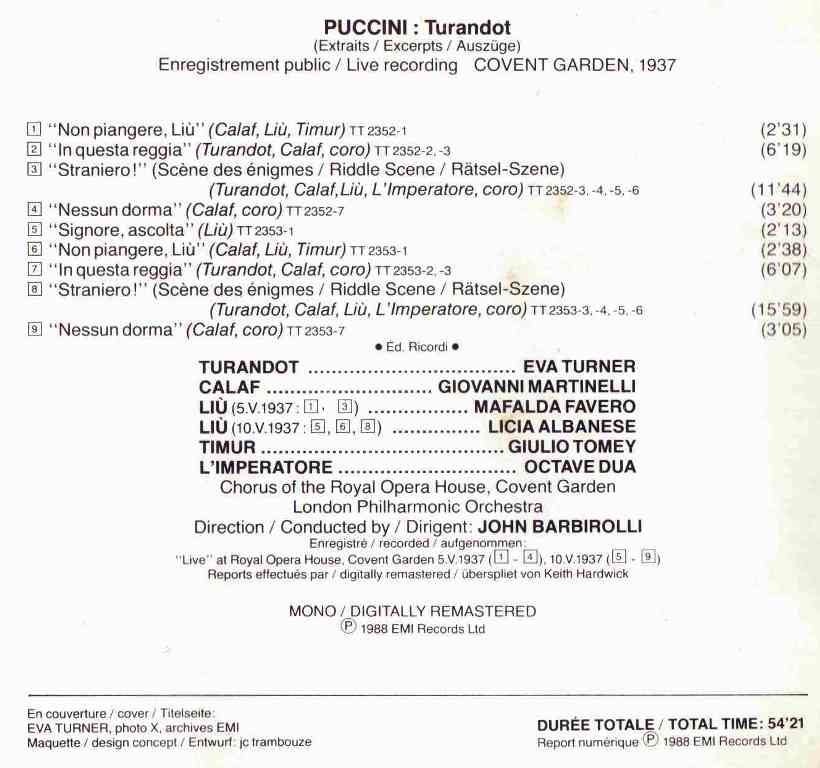
The track listing is shown below, (click on the image for a larger version).
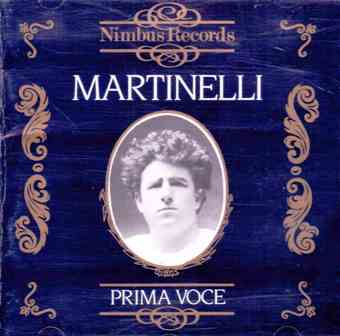
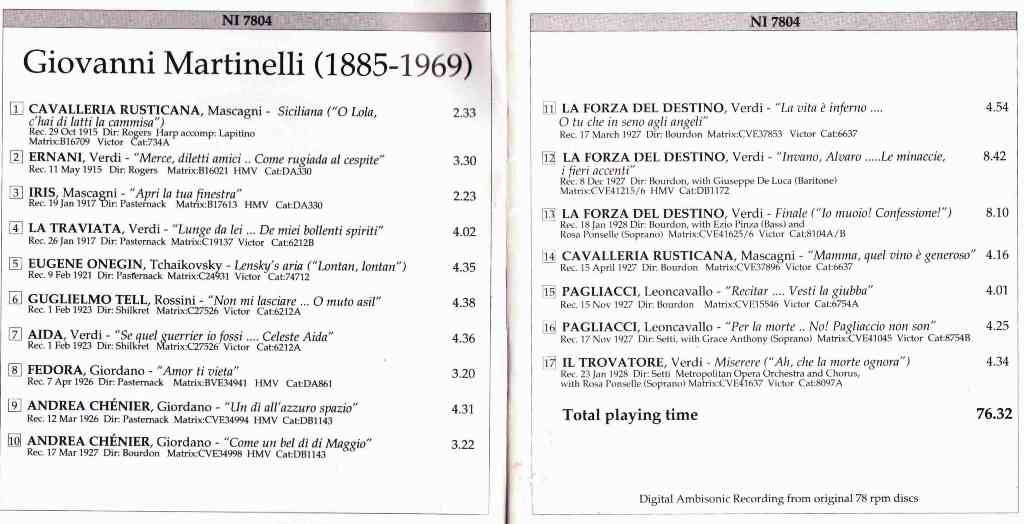
I think the best introduction to Martinelli is the Nimbus CD from their Prima Voce collection, NI7804. It includes extracts from all his earlier operas, Ernani, Guglielmo Tell, Aida, Andrea Chenier, La Forza del Destino and Pagliacci. The recordings are made between 1915 and 1928. The track listing is shown below, (click on the image top bring up a larger version).
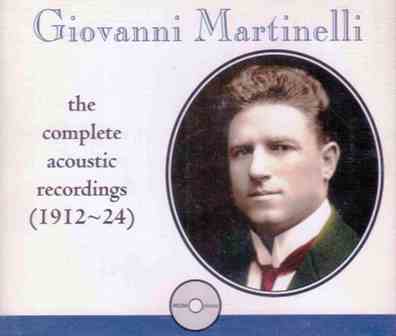
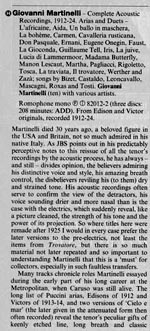
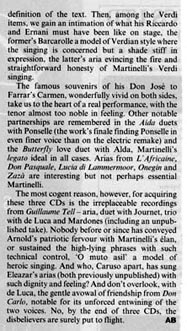 A more complete edition of all his
early acoustic recording between 1912 and 1924 can be found on the
excellent Ward Marston transcribed, Romophone 3 CD collection, 82012-2.
The CD includes recordings of Tosca, La Boheme, La Gioconda, Rogoletto,
Manon Lescaut, Aida, Pagliacci, Un Ballo in Maschera, Il Travatore,
L'Africana, Ernani, Carmen (with Geraldine Farrar), Lucia di Lammermoor,
Marta, Iris, Guglielmo Tell, La Traviata, Don Pasquale, Faust, werther,
La Boheme, Madama Butterfly, Zaza,
Eugene Onegin, Don Carlo, Aida (with Rosa Ponselle) and La Juive as
well as a number of songs. A review of this CD is given on the left,
again from the Gramophone magazine. The excellent sleeve notes are
by John Steane and also provide some additional biographical information.
For example in discussing the 'legend' that is Martinelli he notes
that his death was reported as front page news in The New York Times,
'Martinelli the tenor is dead'. Steane also gives some information
regarding the supposed anomaly as to his date of birth: I quote, 'His
birth certificate, a copy of which exists signed by him "Visto
- confermo", gives the date 22nd October 1885, making him 83 at
the time of his death. He was, however, widely understood to be older:
an unauthenticated report this effect (with a not implausible, though
I think incomplete, account of the reason) is included in an issue
of The Record Collector (vol.25, 7-9 p.151) devoted to him. Italian
authorities have dismissed the idea of a falsified birth certificate
as iimpossible: but in an interview on BBC television in 1967 he gave,
as I remember it, a ruefully humourous
assent when the interviewer, Lord Harewood, said that he believed the
tenors actual age to be even greater than the official 81. In a letter
to me Lord Harewwod confirmed that this was his memory too, although
he could not be sure about how many years were involved. I made a note
at the time that 'five' was mentioned, and this is in accord with The
Record Collector.'
A more complete edition of all his
early acoustic recording between 1912 and 1924 can be found on the
excellent Ward Marston transcribed, Romophone 3 CD collection, 82012-2.
The CD includes recordings of Tosca, La Boheme, La Gioconda, Rogoletto,
Manon Lescaut, Aida, Pagliacci, Un Ballo in Maschera, Il Travatore,
L'Africana, Ernani, Carmen (with Geraldine Farrar), Lucia di Lammermoor,
Marta, Iris, Guglielmo Tell, La Traviata, Don Pasquale, Faust, werther,
La Boheme, Madama Butterfly, Zaza,
Eugene Onegin, Don Carlo, Aida (with Rosa Ponselle) and La Juive as
well as a number of songs. A review of this CD is given on the left,
again from the Gramophone magazine. The excellent sleeve notes are
by John Steane and also provide some additional biographical information.
For example in discussing the 'legend' that is Martinelli he notes
that his death was reported as front page news in The New York Times,
'Martinelli the tenor is dead'. Steane also gives some information
regarding the supposed anomaly as to his date of birth: I quote, 'His
birth certificate, a copy of which exists signed by him "Visto
- confermo", gives the date 22nd October 1885, making him 83 at
the time of his death. He was, however, widely understood to be older:
an unauthenticated report this effect (with a not implausible, though
I think incomplete, account of the reason) is included in an issue
of The Record Collector (vol.25, 7-9 p.151) devoted to him. Italian
authorities have dismissed the idea of a falsified birth certificate
as iimpossible: but in an interview on BBC television in 1967 he gave,
as I remember it, a ruefully humourous
assent when the interviewer, Lord Harewood, said that he believed the
tenors actual age to be even greater than the official 81. In a letter
to me Lord Harewwod confirmed that this was his memory too, although
he could not be sure about how many years were involved. I made a note
at the time that 'five' was mentioned, and this is in accord with The
Record Collector.'
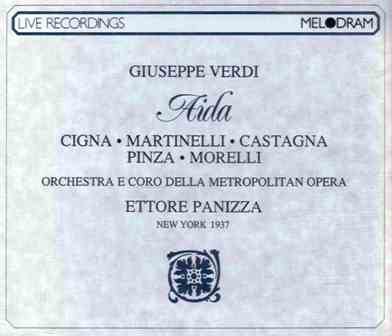
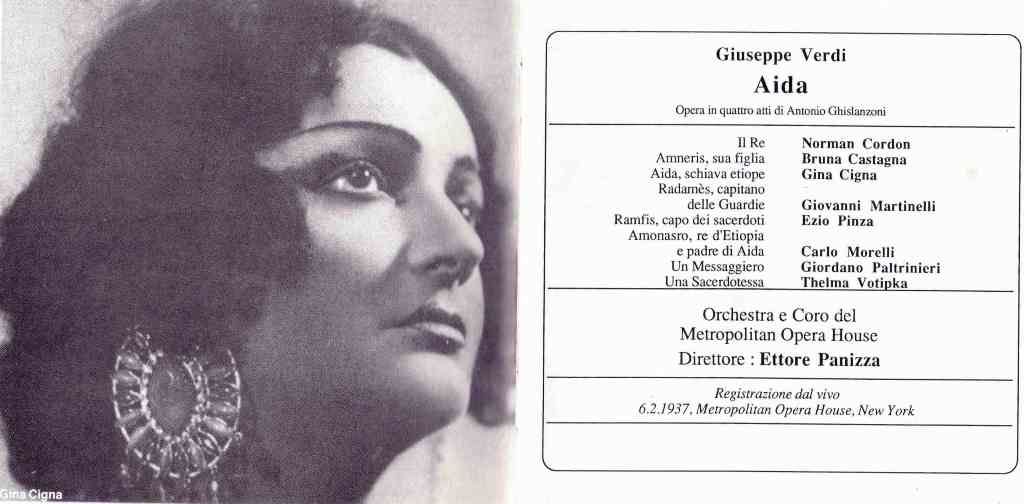
The above CD also makes mention of a recording of Aida made in 1943 with Milanov and Bruna Castagna.
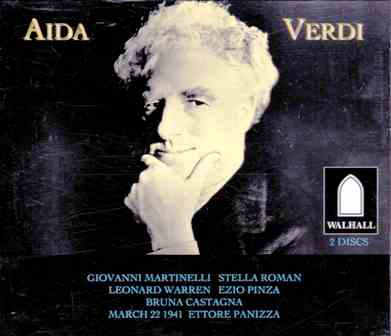
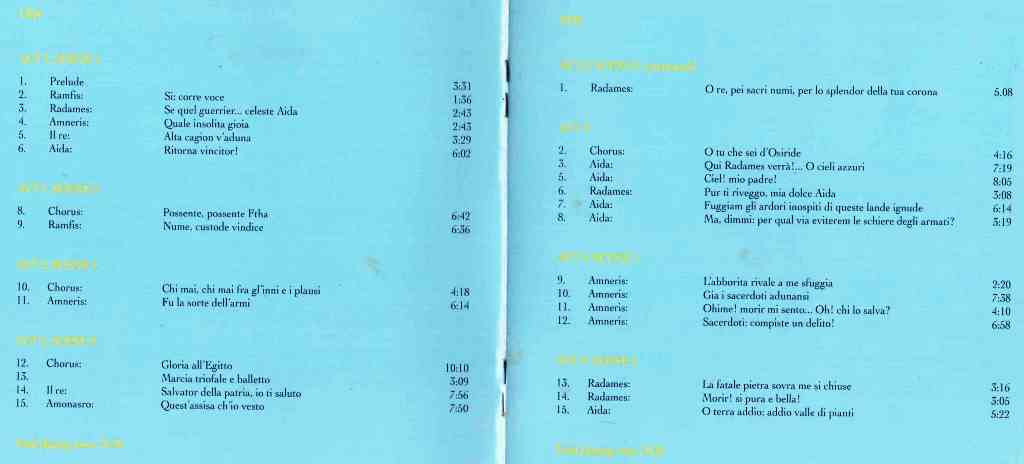
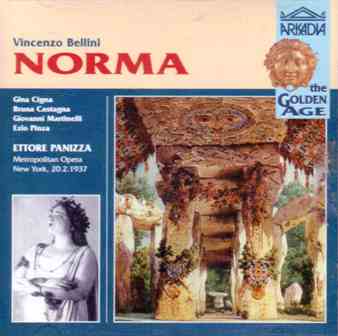
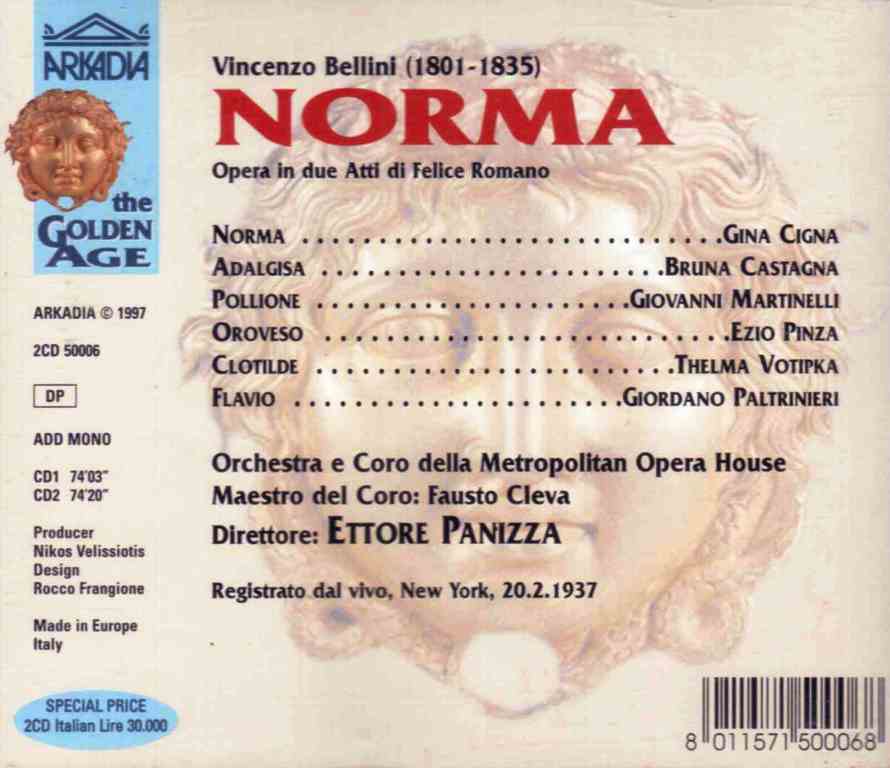
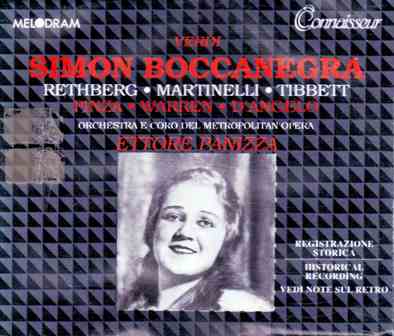
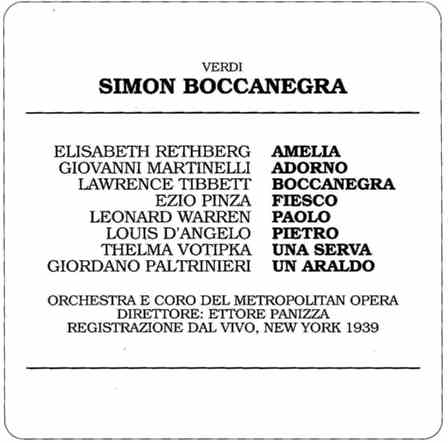
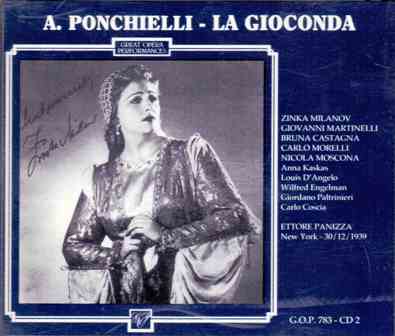
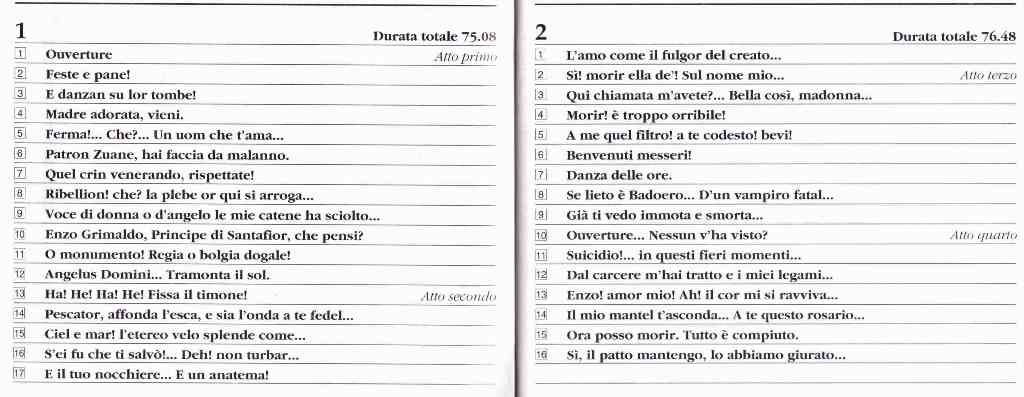
The track listing for this recording is shown below, (click on the image for a larger version).
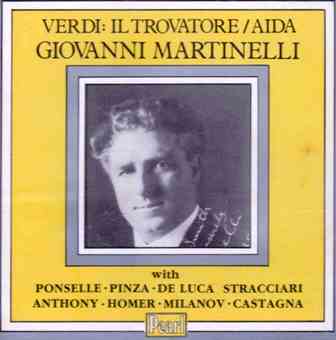
Ín the exerts from Trovatore the listener to these records hears Martinelli's voice first from off stage at a live performance at the Metropolitan in 1938. It is questionable if he would realise that it is the voice of a tenor then fifty-two years or, if in fact the date of his birth is 1880 and not 1885, (as, if memory serves, he seemed to indicate in a television interview with Lord Harewood), then fifty-seven. The sound is still perfectly defined, the vitality undiminished. The final top B flat, incidentally, was a traditional interpolation specifically permitted him by Toscanini in the famous revival of 1915.''
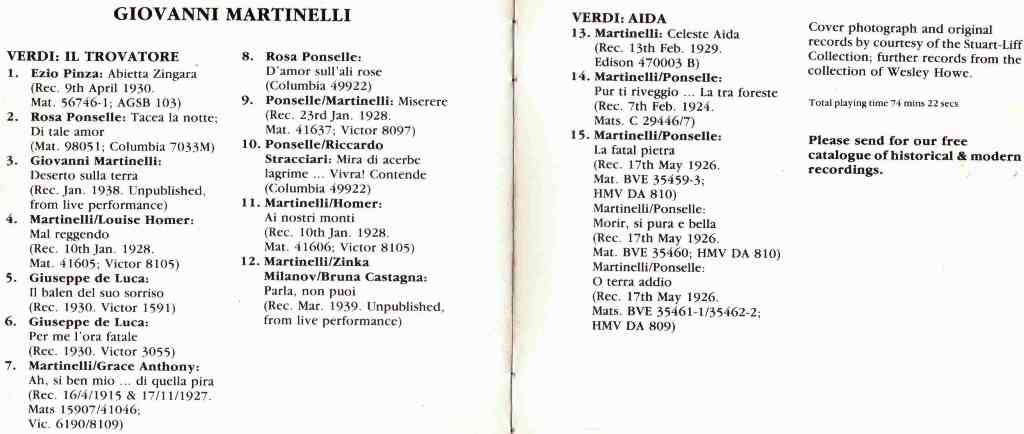
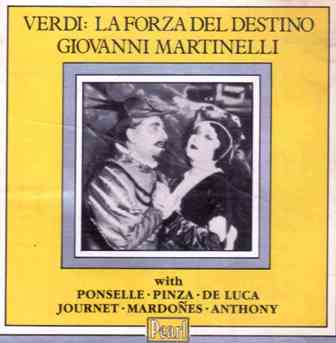
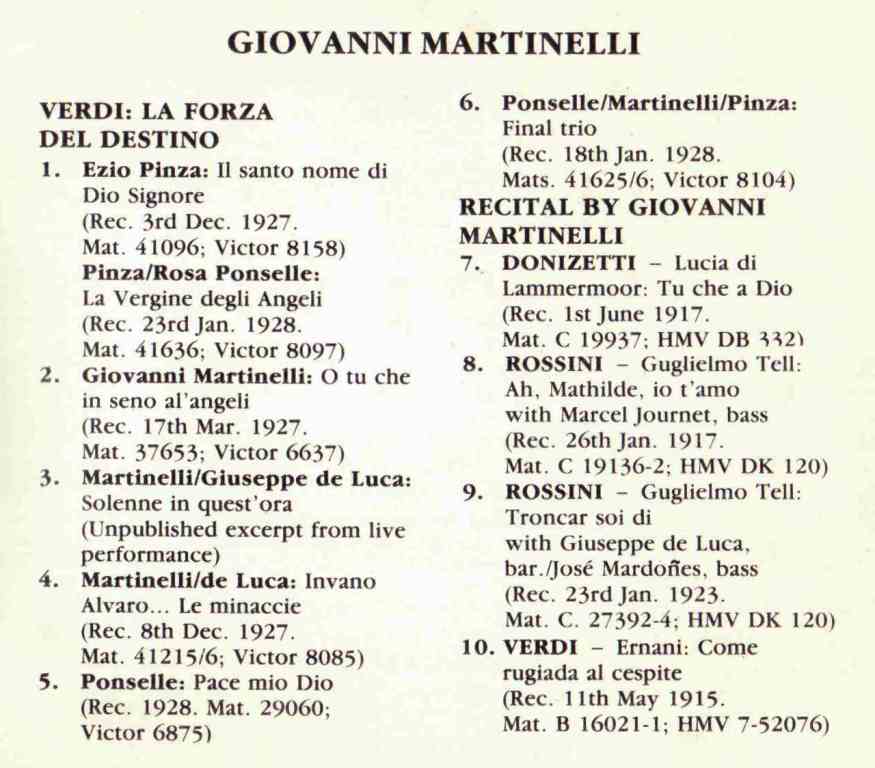
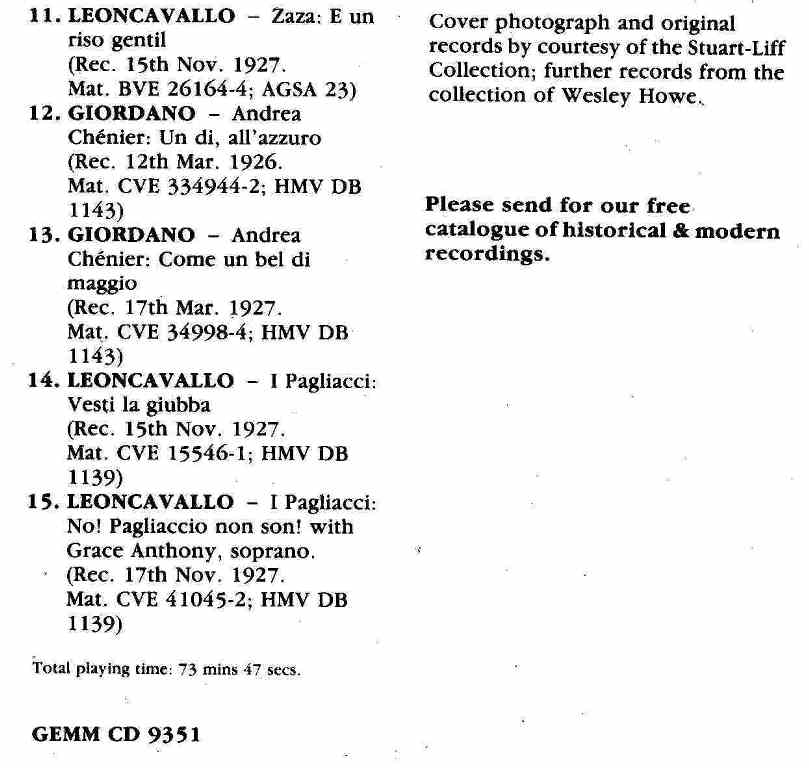
'The recordings from La Forza del Destino show clearly the emotional power of Martinelli's singing. In the recitative and aria Ó tu che in seno degli angeli' , not only is the phrasing uniquely broad and imaginative, but there is a sense of suffering and yearning conveyed with am aristocracy of style devoid of indulgence and self-pity. Then in the duet from Act 4, after 'bowing' the legato phrases so beautifully, he turns in the final outburst', (Ah segnasti la tua sorte'), with a glottal attack and open vowel sound on the high A, stung at last beyond endurance by the taunts of his former friend.'' John Steane.
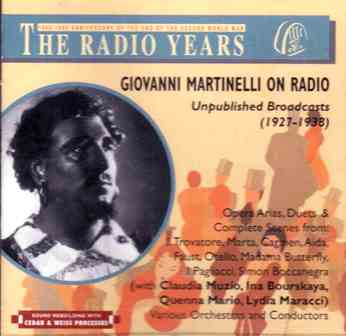
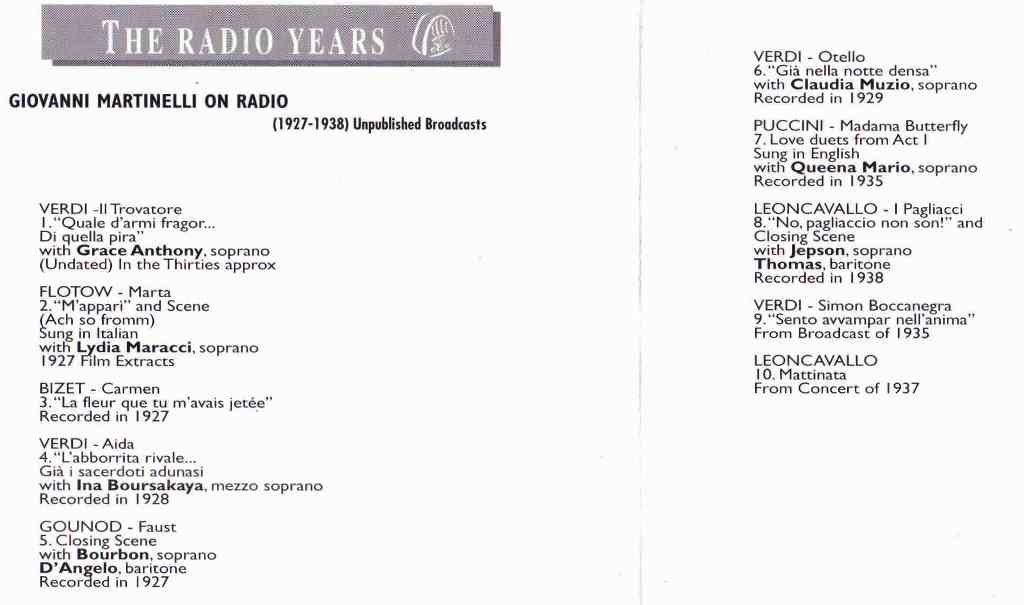
The LPs
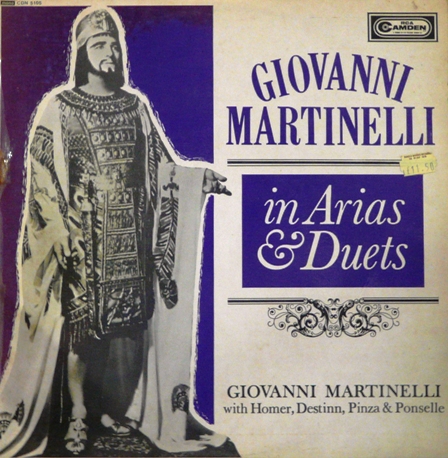
The following is the track list for the above LP (RCA Camden, CDN 5105) together with their source and the year of recording, (this is additional information I have added, I can't guarantee the correctness of this information).
SIDE 1
Band 1: Verdi, Il Trovatore: Mal Reggendo with Louise Homer (1928, DB1215 2-0554271 [A41605]).
Band 2: Verdi, Il Trovatore: Di Quella Pira (1915, 7-52077 [A15943]).
Band 3: Verdi, Il Trovatore: Miserere with Emmy Destinn (1915 DB333 2-054063 [A15906]).
Band 4: Verdi Il Trovatore: Ai nostri monti with Louise Homer (1928, DB1215 2-055427o [A41606]).
Band 5: Verdi, Un Ballo in Maschera: Di tu se fedele (1915, DA523 7-52066 [A15666]).
Band 6: Gounod, Faust: Salut demeure (1918, DB334 2-032053 [A21429]).
Band 7: Roxas, O Ben Tornato Amore (1918, DA523 7-52141 [A21428]).
SIDE 2
Band 1: Verdi Aida: Celeste Aida (1926, DB979 2-052314 [A14237]).
Band 2: Verdi, Aida: Mortal Diletto ai Numi with Ezio Pinza (? or Anthony), Nume Custode e vindice (1927, A41076).
Band 3: Verdi, Aida: La Fatal Pietra with Rosa Ponselle (1926, DA810 7-54043 [A35459]).
Band 3: Verdi, Aida: Morir si pura e bella (1926, DA810 7-54044 [A35460]).
Band 3: Verdi, Aida: O Terra addio Pt.1 (1926, DA809 7-54045 [A35461]).
Band 3: Verdi, Aida: O Terra addio Pt.2 (1926, DA809 7-54046 [A35462]).
Band 4: Introduction by Giovanni Martinelli: Puccini, La Fanciulla del West: Or Son Sei Mesi
The sleeve notes by Richard Bebb and Edward J. Smith include an extract from a lecture, 'The Singing of Verdi', Martinelli gave in London at the Royal Institution (1962 I believe).
"Trovatore was the opera in which I felt closest to Verdi. I guess I have sung at least 250 performances of Manrico. I sang the opera for the first time in Monte Carlo in 1912. It was a good performance, but it was in 1914 that I really began to know what Verdi had written into this opera. Trovatore had been out of the repertoire of the Metropolitan for seven seasons. Toscanini, who had worked hard on the opera with Verdi, was determined to show a Trovatore as Verdi would have wanted it. The result was a veritable revolution in thought on the opera. The first rehearsals for Trovatore were called in October of 1914. We had a minimum of fifty rehearsals of two hours or more duration for each... Our cast included Emmy Detinn, Marguerite Ober, Pasquale Amato and Leon Rothier, as well as myself... Toscanini allowed me the interpolated B flat at the end of Deserto sulla terra and also in Ah! si ben mio. The first aria was made into a minstrels serenade establishing the character of Manrico from the outset, but the warrior in the young man was best exemplified by the concluding high note. Toscanini pointed out that the two verses were identical, and for this reason the B flat was allowed even by Verdi.
...Toscanini stressed the importance of the words in emphasising the story of Trovatore. Ridiculous as it may seem to us, this story is indespensible to the music, for Verdi set every word and every nuance, and unless each is given its relative importance, it loses value and whole interpretation flaters and suffers...
In 1908 I sang the Messenger in Aida. The leading tenor predicted that if I studied well and was serious in my work, in three years I would be singing Radames. In three years I had sung the part of the young Egyptian warrior in the first of some 350 performances - my final appearance as Radames taking place in 1948. I tried ,when I started, to sing the final B flat of Celeste Aida as written - pianissimo - but I found it impossible to sustain a pianissimo on a sustained high B flat. I then began to sing it forte, but felt that Verdi would never have approved. One day, in 1913, I mentioned my misgivings to Giovanni Zanatello. Giovanni then told me of his experience with the aria. In 1898 he had started to shift from baritone to tenor, and he was called upon to sing an audition for Verdi himself. Determined to impress the 85 year old composer, Zanatello sang two magnificent B flats in the Celeste Aida and then attempted the final one as written - pianissimo - and his voice cracked. Giovanni told me his heart was broken, for he felt he had failed miserably. Verdi, however, came to him and told him not to worry - that a fine career was to be his - and that he, Verdi, had written a pianissimo but had never heard a virile tenor sing one and was resigned to a forte note. For my own type of voice the only way such a B flat could be sung, other than forte, would be by using the falsetto which was what Verdi did not want...
...To me Verdi was King. He was my Emporer of Opera, and I was but a disciple gifted by Almighty God with the power to interpret the King of Music's message to the world. That is my epitaph, and no man could have a prouder one."
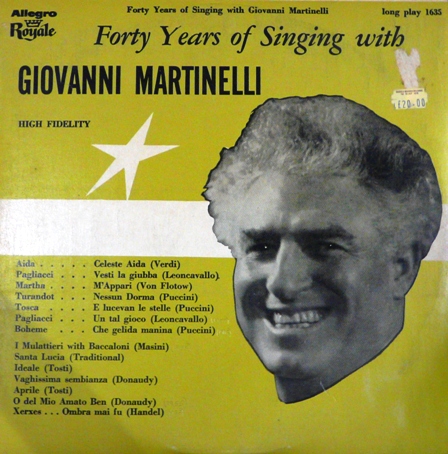
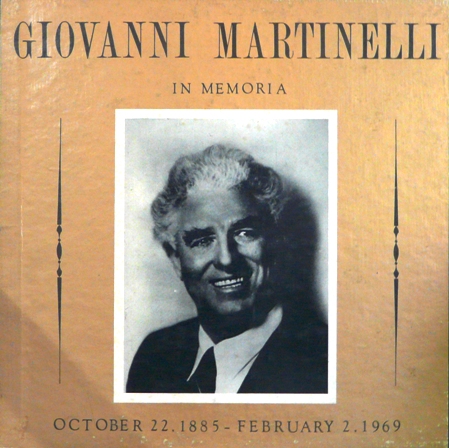
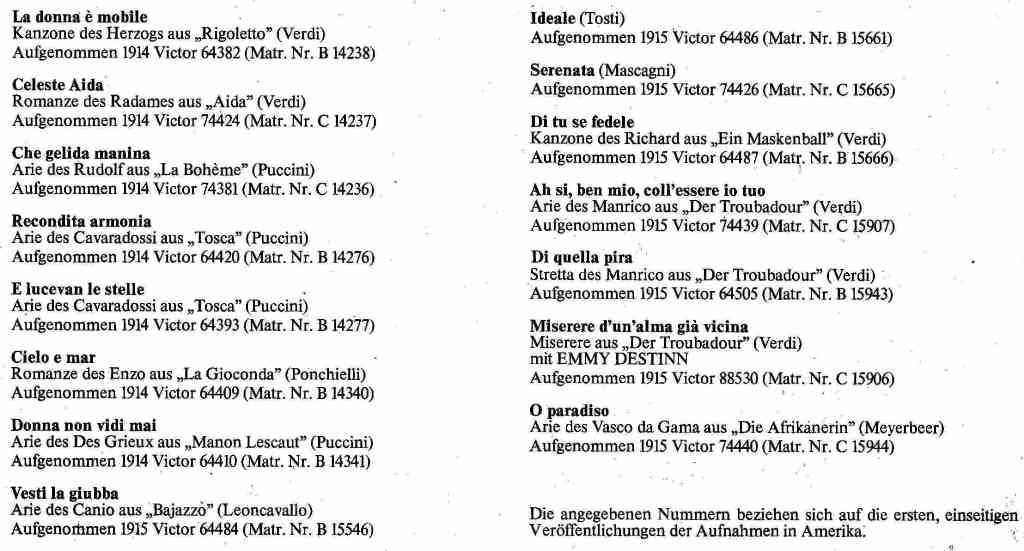
The track listing is shown on the LP cover, above. This LP is from Allegro Royale, No. 1635 (1955).
'In order to complete this album of singing, Martinelli agreed to record a number of selections during 1955. These include Un Tal Gioco from Pagliacci, perhaps his most famous part, the classic Largo from Xerxes of Handel, the comic duet I Mulatierri with his friend and colleague Salvatore Baccaloni, and lastly the Italian song, O del Mio amato ben. This is the first time in recorded history that a tenor in his seventieth year recorded and the results were fantastic.'
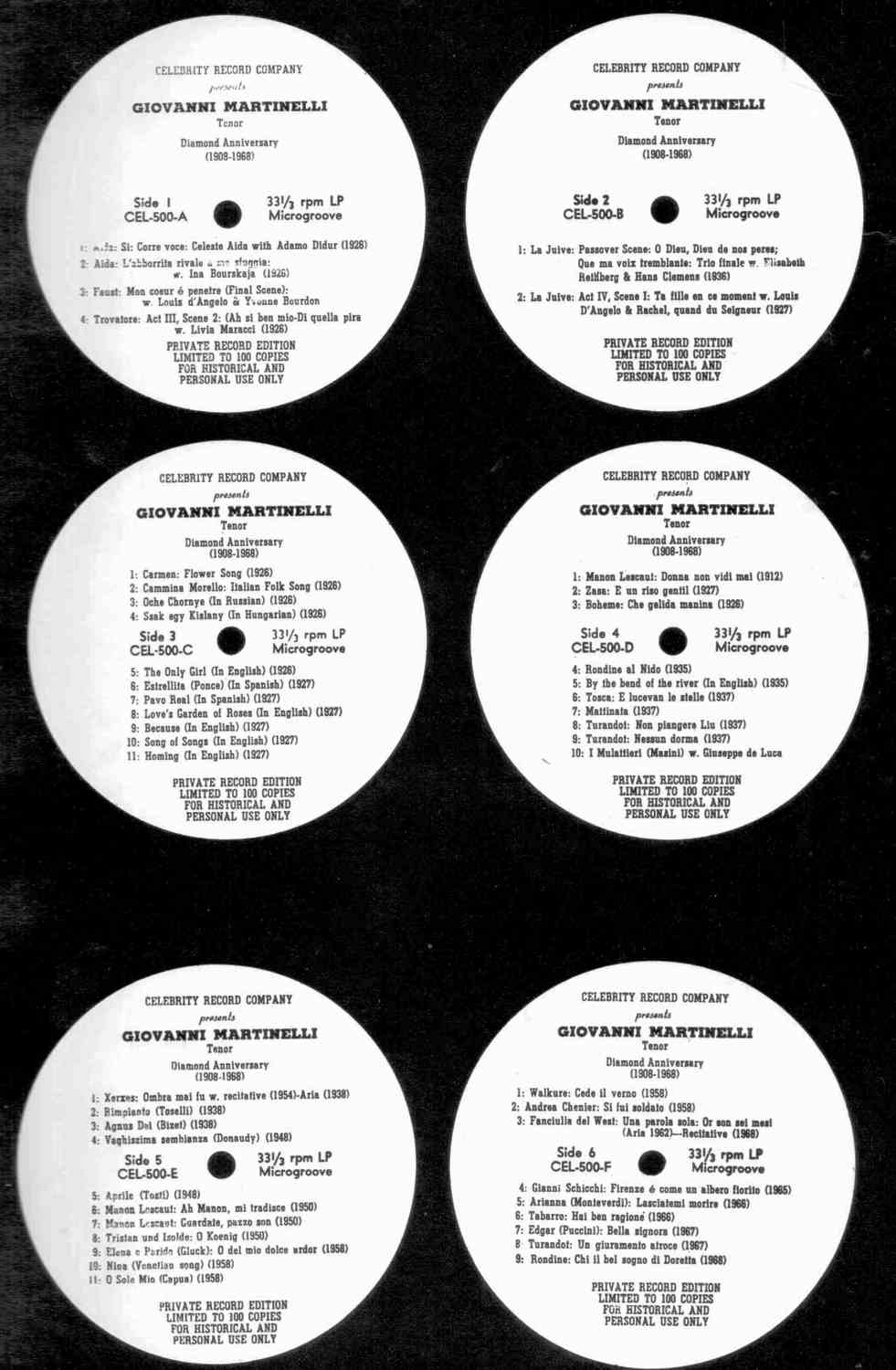
This boxed set of 3 LPs is commented as 'Private record edition. Limited to 100 copies for historical and personal use only. It is issued by the Celebrity Record Company, CEL-500 A/B/C/D/E/F. It comes with a booklet with extensive notes by Edward J Smith (see Biography). The track listing for this LP is shown below, (click on the image to bring up a larger version).
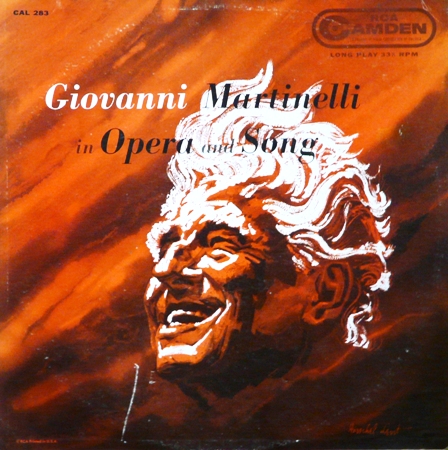
RCA Camden CAL 283.
SIDE 1
1: Verdi, Otello. Dio! Mi potevi scagliar (5/9/1939).
2. Verdi, Otello. Nium mi tema (5/9/1939).
3. Halevy, La Juive. O Dieu Dieu de nos peres si trahison ou perfide (12/24/1928).
4. Bizet, Carmen. Air de la Fleur (5/11/1915).
5. Gounod, Faust. Salut, Demeure (1/25/1918).
SIDE 2
1. Verdi, Ernani. Come rugiada al cespite (5/11/1915).
2. A de-Leva - Fernando Tanara. Nina (6/22/1925).
3. Mascagni. Serenata (2/3/1915).
4. Bizet. Ouvre ton coeur (3/28/1916).
5. Tosti. L'ultima canzone (1/19/1917).
6. Leoncavallo. Mattinata (3/28/1916).
7. Gesu Bambino (4/7/1926).
8. Jules Granier. Hosanna (4/7/1926).
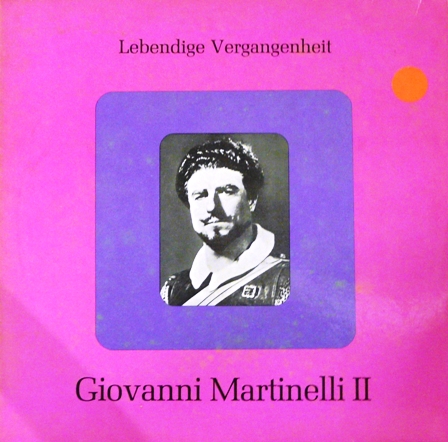
Lebendige Vergangenheit LV271.
The track listing is shown below. (Click on the image for a larger version).
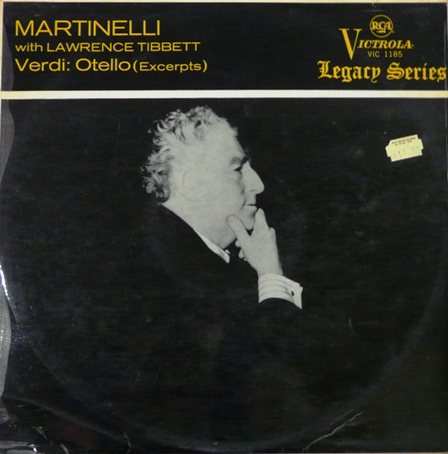
Track listing (RCA Victrola VIC 1185):
SIDE 1
1. Inaffia L'ugola (Brindisi) [Lawrence Tibbett, Nicholas Massue, Herman Dreeban].*
2. Gia nella notte densa (Love duet) [Giovanni Martinelli, Helen Jepson].
3. Credo in un dio crudel [Lawrence Tibbett].*
4. Ora e per sempre [Giovanni Martinelli, Lawrence Tibbett].
5. Era la notte, Cassio dorma (Cassios' Dream). [Lawrence Tibbett].*
SIDE 2
1. Oh! Monstruosa colpa! [Giovanni Martinelli, Lawrence Tibbett].
2. Dio! Mi potevi Scagliar. [Giovanni Martinelli, Lawrence Tibbett].
3. Vieni. L'aula e deserta. [Giovanni Martinelli, Lawrence Tibbett, Nicholas Massue].*
4. Piangea Cantando (Willow song) - Ave Maria [ Helen Jepson].
5. Nium mi tema (Death of Otello) [Giovanni Martinelli].
* Recorded May 3rd 1939
All others recorded May 9th 1939
'Apart from the opening Esultate the basic essentials to the role are here. That Martinelli would have sung a thrilling account of Otello's entrance is amply born out by his thrilling delivery of Ora e per sempre addio and the declamatory fevour he brings to Si Pel Ciel. The voice here has a bronze-like brilliance and sheen but is scaled down to exquisite raptness in the Love Duet. The Death Scene, Nium mi tema, has the inner despair of finality but perhaps the highlight and emotional core of Martinelli's assumption is his heart rending account of the third act monologue, Dio, mi potevi scagliar, in which he lays bear the grief-stricken agony of a soul in ruins. So masterly and all embracing a performance leaves leaves one with only one regret - that it was not recorded complete.' Delcie Howard.
All material on danploy.com is the copyright of danploy.com (2004-2024) unless otherwise acknowledged.